
Table of Contents
ToggleWhy Every Marketer Needs AEO Skills in 2026
Short answer: Because search itself has changed. Google, ChatGPT, Perplexity, and Copilot are no longer just returning ten blue links — they’re reading the web and handing users a ready-made answer. If your content isn’t structured to be picked up, summarised, and cited by these AI systems, you become invisible even if you’re “ranking.” That’s why Answer Engine Optimization (AEO) has moved from a buzzword to a core skill that every digital marketer — from a fresher to a freelancer — needs to master alongside SEO.
If you’re a graduate hunting for your first marketing job, a working professional worried about being left behind, a freelancer trying to justify higher rates, a Class 12 student mapping out a career, or a homemaker planning a comeback into the workforce — this shift affects you directly. Not next year. Now. Let’s break down exactly why, and what it means for your career.
What Is AEO, in Plain Words?
AEO stands for Answer Engine Optimization — the practice of structuring content so AI-driven platforms (Google AI Overviews, ChatGPT, Perplexity, Gemini, Copilot) can easily extract it and use it as the direct answer to a user’s question.
Where traditional SEO asks, “How do I rank higher on the results page?”, AEO asks a sharper question: “How do I become the answer, even if the user never clicks through to my website?”
Both goals matter. But the second one is now unavoidable, because of how differently people are searching.
Why 2026 Is the Turning Point
This isn’t a gradual trend anymore — it’s a measurable shift in user behaviour:
- Industry tracking from SparkToro and similar clickstream studies shows that a majority of Google searches in 2026 now end without any click at all — the user gets their answer directly on the results page.
- When an AI Overview appears at the top of a search, click-through rates to the actual websites drop sharply, in some studies by over half.
- Google’s AI Mode alone has crossed a billion monthly users, and that number is compounding every quarter.
- Platforms like ChatGPT now handle hundreds of millions of weekly queries — many of which used to start as a Google search.
| Metric | What It Means for Marketers |
|---|---|
| Majority of searches end with zero clicks | Ranking #1 no longer guarantees traffic |
| AI Overviews sharply cut click-through rates | Being "the answer" matters more than being "a link" |
| AI Mode usage doubling every quarter | The audience is actively migrating to answer engines |
| Branded searches still convert well in AI Overviews | Brand and authority-building now directly drives visibility |
The takeaway is simple: brands and marketers who only chase rankings are optimising for a shrinking slice of user behaviour. The people who understand both SEO and AEO are the ones agencies and companies are actively hunting for.
SEO vs AEO vs GEO — Clearing the Confusion
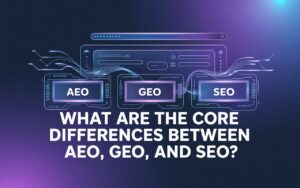
Most students starting out get these three terms mixed up, and honestly, so do a lot of working professionals. Here’s the distinction in one table:
| Aspect | SEO | AEO | GEO |
|---|---|---|---|
| Goal | Rank high on the search results page | Be picked as the direct answer | Get cited/recommended inside AI-generated responses |
| Primary platforms | Google, Bing search results | Featured snippets, AI Overviews, voice assistants | ChatGPT, Perplexity, Claude, Gemini |
| Content style | Keyword-optimised, long-form | Concise, structured, question-and-answer format | Fact-dense, quotable, source-backed |
| Success metric | Rankings, organic traffic | Snippet/answer box visibility | Citations and brand mentions in AI answers |
| Core requirement | Backlinks, technical SEO, on-page optimisation | Schema markup, clear formatting, FAQs | E-E-A-T signals, structured data, topical authority |
A single blog post going deep into the difference between aeo geo and seo is worth bookmarking if you want to understand each layer before you start applying it in real client work.
The three aren’t rivals — they overlap. Strong technical SEO and backlinks still build the authority that gets you cited in AI answers. Think of SEO as the foundation, and AEO/GEO as the newer floors being built on top of it.
The Real Pain Point: Why This Worries Job Seekers and Freelancers
Here’s what nobody tells you upfront, and why this topic matters beyond theory:
- Freshers and graduates are being asked in interviews to explain AI Overviews and structured data — not just meta tags and keyword density.
- Working professionals in traditional SEO roles are watching job descriptions shift to include “AEO,” “GEO,” and “AI search visibility” as required skills, not nice-to-haves.
- Freelancers are losing bids to competitors who can show clients how to appear inside ChatGPT and AI Overviews, not just rank on page one.
- Class 12 pass-outs exploring digital marketing as a career often build skills around an outdated version of SEO, only to find the job market has already moved on.
- Homemakers re-entering the workforce need skills that are current enough to compete with candidates who’ve been continuously working — and AEO is one of the few areas where almost everyone is still catching up, which levels the playing field.
The uncomfortable truth is that “I know SEO” is no longer a strong enough answer in a job interview or a client pitch. Recruiters and clients are actively screening for people who understand how answer engines choose sources.
What Changes in Your Day-to-Day Marketing Work
If you’re going to future-proof yourself, here’s what shifts in practice:
- Content structure over keyword stuffing: Short, direct answers near the top of the page, followed by depth — not paragraphs built around repeating a keyword.
- FAQ and How-To formatting: Structuring content around real questions people ask, using schema markup so answer engines can extract it cleanly.
- E-E-A-T becomes non-negotiable: Experience, Expertise, Authoritativeness, and Trustworthiness signals (author bios, credentials, original data) now directly influence whether AI tools trust and cite your content.
- Multi-platform visibility: Being present and credible on Reddit, Quora, YouTube, and niche forums — because AI systems frequently pull from these communities, not just company websites.
- New measurement skills: Tracking share of voice inside AI answers and monitoring impressions-without-clicks in Search Console, instead of relying only on traditional ranking reports.
None of this replaces SEO fundamentals — it builds on them. A marketer who never learned technical SEO, keyword research, or link building will struggle to do AEO well, because AEO depends on the same trust signals SEO has always required.
Is This a Good Time to Start a Career in Digital Marketing?
If you’re worried this shift makes digital marketing riskier to get into, it’s worth flipping that thinking. Every major shift in search — mobile-first indexing, voice search, now AI answers — has expanded the number of marketing roles, not shrunk them, because businesses always need someone to adapt their visibility strategy.
If you’re weighing your options, this detailed breakdown of Is Digital Marketing a Good Career walks through the realistic earning potential, job roles, and growth paths available right now, including where AEO specifically fits in.
For freelancers and homemakers especially, this is a rare window: since AEO is new enough that even experienced professionals are still learning it, a motivated beginner with the right training can catch up to — and sometimes overtake — someone with five years of outdated SEO-only experience.
How Long Does It Actually Take to Get Job-Ready?
This is usually the first question every serious learner asks, and it deserves a direct answer, not a vague “it depends.”
Most learners with consistent effort — around 2 to 3 hours a day — can build a solid, employable foundation in SEO, Google Ads, social media, and the fundamentals of AEO within a few months, with the timeline varying based on your starting point and how hands-on your training is.
If you want the exact breakdown by skill area and experience level, this guide on How Long Does It Take to Learn Digital Marketing? covers realistic timelines for graduates, working professionals, and complete beginners separately, so you can set expectations based on your own situation.
Who Should Actually Be Learning This Right Now
| Who You Are | Your Core Concern | Why AEO + SEO Skills Solve It |
|---|---|---|
| Recent graduate | "I have a degree but no practical skill employers want" | Combined SEO/AEO training gives you a portfolio-ready, in-demand skill set from day one |
| Working professional | "My current role feels stagnant or outdated" | Adding AEO to your existing SEO base makes you promotable and harder to replace |
| Freelancer | "I'm competing on price, not value" | AI-visibility skills let you charge premium rates most freelancers can't yet offer |
| Class 12 pass-out | "I don't know which career to choose after school" | A practical, skill-first path into a growing field without needing a traditional degree first |
| Homemaker returning to work | "I've been out of the workforce and worry I'm behind" | AEO is new enough that everyone is learning together — your gap in years matters less here |
Building the Right Skill Stack
A structured, mentor-led digital marketing course that treats AEO as a core module — not an afterthought — is genuinely the fastest way to close this gap, especially if you’re starting from zero or transitioning from an unrelated field. Self-teaching through scattered YouTube videos works for some people, but it usually leaves gaps in the exact areas — schema markup, structured content, E-E-A-T — that hiring managers and clients now test for directly.
Look for a program that covers technical SEO, Google Ads, content strategy, and AI/answer-engine visibility together, with real client-facing projects, rather than one that treats AEO as a single bonus lecture tacked onto an SEO-only syllabus.
Frequently Asked Questions
No. AEO builds on SEO fundamentals like backlinks, technical optimisation, and content quality. Think of it as an additional layer, not a replacement.
No. You need to understand structured data and schema markup conceptually, and most tools let you implement this without writing code from scratch.
Yes, and it's actually easier to learn them together now, since course curriculums are being redesigned to teach both as one connected skill rather than two separate subjects.
Yes. Recruiters and clients increasingly screen for AI-search awareness specifically, because most existing SEO professionals haven't upskilled yet — which works in your favour if you have.
The Bottom Line
Search didn’t stop being about SEO — it expanded to include AEO. Marketers who understand only one half of this equation are going to find themselves competing for a shrinking pool of opportunities, while those who master both will be the ones companies and clients actively seek out. Whether you’re starting fresh, switching careers, or upskilling from where you already are, the smartest move right now is to build both skill sets together, before this becomes the baseline expectation rather than the differentiator it still is today.